Welcome to my Lab Book!
- Author
Jonathan Pieper






This Lab Book is a review of my work at the AG Müller (Goethe University Frankfurt). It also contains supplemental information and data descriptions to my master thesis.
Abstract
The detailed understanding of micro–and nanoscale structures, in particular their magnetization dynamics, dominates contemporary solid–state physics studies. Most investigations already identified an abundance of phenomena in one–and two–dimensional nanostructures. The following thesis focuses on the magnetic fingerprint of three–dimensional \(\mathrm{CoFe}\) nano–magnets, specifically the temporal development of their hysteresis loop. These nano–magnets were grown in a tetrahedral pattern on top of a highly susceptible home–build \(\mathrm{GaAs}/\mathrm{AlGaAs}\) micro–Hall sensor using focused electron beam induced deposition (FEBID).
During the measurements, utmost efforts were employed to exemplify
current best research practices. The data life cycle of the present
thesis is based upon open–source data science tools and packages. Data
acquisition and analysis required self–written automated algorithms to
handle the extensive quantity of data. Existing instrumental–controlling
software was improved, and new Python packages were devised to analyze
and visualize the gathered data. The open–source Python data analysis
framework (ana) was developed to facilitate computational
reproducibility. This framework transparently analyses and visualizes
the gathered data automatically using Continuous Analysis tools based on
GitLab and Continuous Integration. This automatization uses bespoke
scripts combined with virtualization tools like Docker to facilitate
reproducible and device–independent results.
The hysteresis loops reveal distinct differences in subsequently measured loops with identical initial experimental parameters, originating from the nano–magnet’s magnetic noise. This noise amplifies in regions where switching processes occur. In such noise–prone regions, the time–dependent scrutinization reveals presumably thermally induced metastable magnetization states. The frequency–dependent power spectral density uncovers a characteristic \(1/f^2\) behavior at noise–prone regions with metastable magnetization states.
Summary and Conclusion
The present study aims to find and characterize fluctuations in the magnetic fingerprint of three–dimensional nano–tetrapods. These tetrapods were deposited by means of focused electron beam induced deposition (FEBID) on top of a micro–Hall magnetometer. The micro–Hall measurements scrutinized the magnetic fingerprint by measuring the nanostructures’ stray–field during an external field sweep and obtaining the hysteresis loop. Repetitions of identical experiments yield several, nearly equivalent hysteresis loops that differ in noise–prone regions near the remanence. These noise–prone regions are further investigated using statistical methods to determine the noise’s power spectral density (PSD).
During the process of data acquisition and analysis, utmost efforts were employed to comply with current best research practices. In general, the data processing steps involve customized, self–written computer algorithms that are freely available and fundamentally documented. Based on experiences, the workflow’s documentation process evolved from proprietary OneNote notebooks towards an open–source driven Continuous Analysis infrastructure, allowing automated data analysis and interoperable documentation. In detail, a self–maintained GitLab server provides the infrastructure to manage git repositories that version–control data, code, and documentation. In addition, Continuous Integration tools automate tasks and increase productivity. These aforementioned data processing and workflow steps have been fundamentally documented, converted into a presentable format, and made online available via the supplemental information.
The noise investigations utilized two separate methods to dissect the Hall signal of the nano–tetrapods during an external field sweep. Firstly, a signal–analyzer examines the signal’s PSD \(S_V (f)\) in the frequency domain. This examination discloses a \(1/f^2\) correlation of the PSD only when measuring the stray–field during an external magnetic field sweep inside a noise–prone region. This correlation is noteably invariant to changes in the temperature or sweeprate. A novel data acquisition technique (SR830DAQ) further scrutinizes this fluctuating nature of the nano–tetrapods’ magnetic response. This SR830DAQ technique corroborates preceding findings on \(1/f^2\) correlations. Additionally, sensitive fluctuations, although not detectable in a pre–amplified signal with the signal–analyzer, measured by the SR830DAQ technique, reveal a \(S_V \sim I^2\) current dependence of the PSD and confirming expectations. Closer inspection of the persisting time–signal of interrupted field sweeps inside the hysteresis loop’s noise–prone regions exposes metastable magnetization states with spontaneous switching processes. The author deduces that this spontaneous switching originates from thermal activation processes.
Key Points
Best practices were pursued by fundamentally documenting and publishing both, data workflow and analysis methods. A self–written Python data analysis framework (
ana) was created for a transparent evaluation and Continuous Analysis methods were employed to automate time–invasive tasks.The magnetic fingerprint of FEBID deposited three–dimensional nano–tetrapods revealed fluctuations with a characteristic \(1/f^2\) behavior. These characteristics were further investigated by means of data acquisition methods. The time–signal at magnetization states with assumed complex, vortex–like magnetization discloses metastable states with spontaneous switching processes. These switching processes are concluded to arise from thermally activation.
Important
You can find all information about the data and measurements inside the exported OneNote Notebooks and the used software to acquire, analyze, and visualize the data:
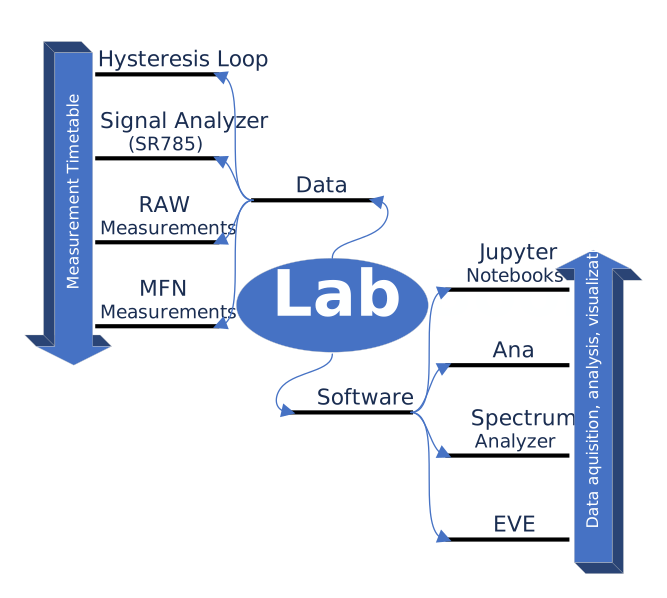
Fig. 1 Structure of this Lab Book.
OneNote
- The exported OneNote notebooks containing all parameters:
Data and Measurements
EVE
- The main software used to control and communicate with the instruments EVE:
Data Analysis
- The notebooks generating the figures:
- The analysis framework which analyzed the data:
Lab Book
Software
- Jupyter Notebooks
- Data Analysis Framework (Ana)
- SpectrumAnalyzer
- Efficient Virtual Environment (EVE)
- Python Scripts
Additional Information